
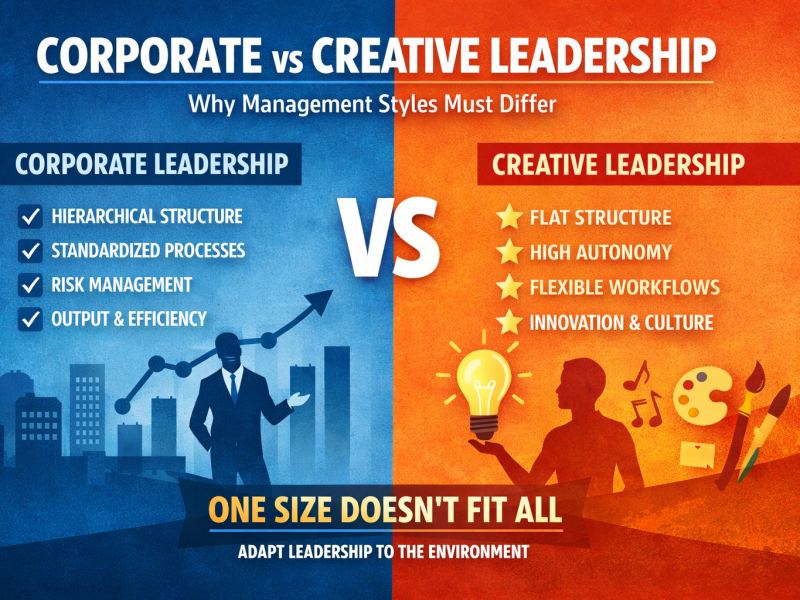
As Africa’s creative economy continues to grow, many creative organisations adopt traditional corporate management structures in pursuit of scale and stability. While this can bring efficiency, it often limits creativity, innovation, and cultural relevance.
The reality is simple: creative organisations and corporate organisations require different leadership and management styles to succeed.
What Good Leadership Has in Common
Regardless of industry, effective leadership is built on a few shared fundamentals:
-
Clear vision and direction
-
Accountability and trust
-
Transparent communication
-
A focus on results and long-term sustainability
However, the way these principles are applied must change depending on the nature of the organisation.
Corporate Leadership: Built for Scale and Control
Corporate organisations are designed to manage risk and operate efficiently at scale. Their leadership and management styles typically emphasise:
-
Hierarchical structures
-
Standardised processes and KPIs
-
Clear reporting lines
-
Centralised decision-making
-
Predictability and risk management
This model works well in environments where consistency and control are essential.
Creative Leadership: Designed for Ideas and Impact
Creative organisations—such as media houses, radio platforms, music businesses, and digital content studios—depend on originality and emotional connection.
Successful creative leadership prioritises:
-
Flatter team structures
-
Autonomy and trust
-
Flexible workflows
-
Leaders as curators and editors, not controllers
-
Psychological safety for experimentation
Creativity thrives when people feel trusted and empowered to take risks.
Why Corporate Management Often Fails Creative Teams
Applying rigid corporate management models to creative environments often leads to:
-
Too many approval layers
-
Safe, forgettable output
-
Burnout and talent loss
-
Focus on volume over quality
Creativity cannot be managed the same way as operational efficiency.
The Hybrid Model: The Most Effective Approach
The most successful creative organisations adopt a hybrid leadership model:
-
Corporate discipline for finance, operations, and partnerships
-
Creative freedom for content, storytelling, music, and programming
Instead of placing structure on top of creativity, they build structure around it.
Final Thought
Leadership is about creating the right conditions for people to do their best work.
-
Corporate organisations succeed through clarity and control.
-
Creative organisations succeed through trust, vision, and protection of creative space.
Trying to lead both in the same way often results in either efficient mediocrity or unstructured chaos. The real skill lies in knowing which rules to enforce—and which to let go.